You customized a resume for a marketing assistant role, attached a few social posts, and applied to a listing marked “remote.” Then the rejection arrives, or nothing arrives at all. The frustrating part is that you may have the basic skills, yet still fail before a hiring manager sees your application.
Remote marketing assistant jobs aren't office roles moved online. Employers assess location, time-zone coverage, written communication, tool fluency, independence, and evidence of measurable work before they decide whether to schedule an interview. The candidates who understand those filters build a much stronger path from application to offer.
Table of Contents
- Why Remote Marketing Assistant Roles Are Harder to Land Than You Think
- Finding the Right Remote Marketing Opportunities
- Building a Resume and Portfolio That Proves Remote Readiness
- How Virtustant Jobs Can Help
- Writing Outreach Messages That Actually Get Responses
- Preparing for Remote Marketing Assistant Interviews
- Understanding Remote Marketing Assistant Salaries and Compensation Models
- Thriving in Your First 90 Days as a Remote Marketing Assistant
Why Remote Marketing Assistant Roles Are Harder to Land Than You Think
A capable early-career applicant often loses out for reasons that have little to do with motivation. Their resume says they “helped with social media,” “supported campaigns,” or “created content,” but it doesn't show which tools they used, what they delivered, or how a manager could verify the work. An automated screen may also reject them because the posting requires a particular location, work authorization, or schedule.
Remote hiring creates a wider candidate pool, which makes employers more cautious about ambiguity. A company may need someone who can work during U.S. business hours, access customer data under a specific employment arrangement, or coordinate with a team that rarely meets live. The word “remote” doesn't remove those constraints.

The signals hiring managers look for
When I review an assistant application, I'm looking for evidence in four areas:
- Operational clarity: Can the candidate turn a campaign brief into tasks, owners, deadlines, approvals, and reporting?
- Tool familiarity: Have they worked with platforms such as HubSpot, GA4, Mailchimp, Asana, Notion, Looker Studio, or a comparable system?
- Written judgment: Can they ask a precise question, summarize a decision, and flag a blocker without creating another round of confusion?
- Outcome awareness: Do they understand reach, click-through rate, conversion rate, cost per acquisition, and other measures relevant to the assignment?
A list of software names isn't enough. A stronger bullet says, “Built a UTM-tagged campaign tracker in Google Sheets and prepared a weekly channel report,” because it demonstrates a workflow. If the project is personal or academic, state it clearly. Verifiable practice is more useful than inflated experience.
Remote readiness must appear before the interview
Distributed teams can't rely on someone sitting nearby to reveal whether work is progressing. Your application should therefore show how you make progress visible. Include examples of written briefs, status updates, documented handoffs, or dashboards, even if you created them for a volunteer project.
Research involving more than 61,000 Microsoft employees found that full-time remote work made collaboration networks more siloed, reduced cross-group collaboration time by approximately 25%, slowed the addition of new collaborators, and shifted communication toward email and messaging rather than real-time discussion, as described by the UC Berkeley Haas research summary. That finding explains why employers value candidates who can create context in writing rather than waiting for a meeting.
Practical rule: Treat every application document as a sample of how you'll operate remotely. Make ownership, tools, decisions, and next steps easy to find.
Traditional resumes also fail because they describe effort instead of proof. “Scheduled posts” tells me what you touched. “Maintained a content calendar, prepared platform-specific copy, routed assets for approval, and recorded publication status” tells me how you work. Add a result where one exists, but never invent a number to make a bullet look stronger.
Finding the Right Remote Marketing Opportunities
Start with eligibility, not enthusiasm. Before you save a listing, identify the employer's permitted geography, employment model, working hours, language requirements, and access restrictions. A “remote” position may still be limited to a country, region, or time zone because of payroll, employment law, data security, or manager availability.
Build a narrow search pipeline
Use several sources, but give each one a job:
- Company career pages: Target agencies, SaaS companies, ecommerce brands, and startups whose marketing work is already distributed.
- Specialist job boards: Search for marketing assistant, growth assistant, lifecycle marketing assistant, SEO assistant, marketing coordinator, and content operations roles.
- Startup communities: Follow product launches, founder communities, and agency networks where early marketing work may appear before a formal job description exists.
- Professional referrals: Ask marketers, project managers, and operations specialists for introductions based on a specific capability, not a general request for “anything remote.”
Set alerts for combinations such as “marketing assistant” plus “remote,” “HubSpot,” “GA4,” “SEO,” “email marketing,” or “content operations.” Review each alert quickly, because high-fit roles attract attention fast. Don't apply because the title contains “assistant.”
For a focused source of opportunities connected to startup work, use Aura++’s marketing job board as one part of your search rather than treating any single board as complete.
Separate genuine flexibility from a remote label
Look for operational clues in the posting. A serious distributed employer usually explains expected hours, communication tools, reporting lines, and the way work is assigned. Vague language about “working independently” without a defined manager, deliverables, or payment terms deserves scrutiny.
Ask these questions before applying:
- Does the company state where applicants may live?
- Does it identify employee, contractor, freelance, or agency employment?
- Does it specify overlapping hours or merely say “flexible”?
- Does the role involve CRM, customer, payment, or social-account access?
- Are the interview stages and practical tasks clearly described?
- Can you find real employees, a company website, and a credible product?
A listing that asks applicants to pay for training, equipment, or certification is a warning sign. So is a role with no clear responsibilities, no identifiable employer, or compensation based entirely on vague promises. Remote work expands access, but it also makes verification your responsibility.
Building a Resume and Portfolio That Proves Remote Readiness
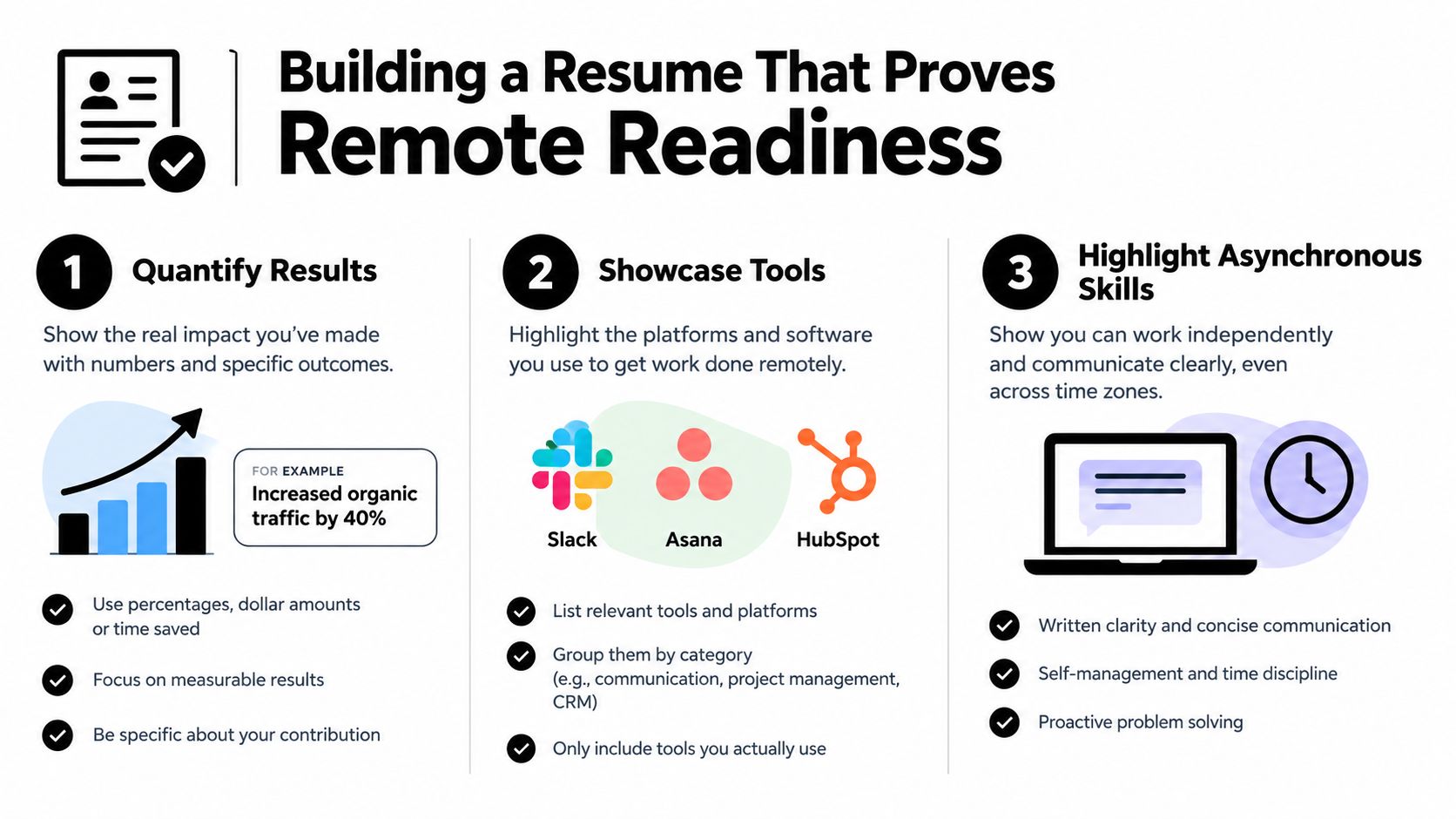
Remote employers can't watch you complete routine work, so they judge the evidence you leave behind. Your resume should show what you executed, which system you used, and how the team could evaluate it. Your portfolio should then let a hiring manager inspect the work without asking you to explain every basic decision live.
A useful resume bullet follows this pattern:
Action + marketing task + tool or process + business measure or deliverable.
For example, “Created an SEO content brief using keyword intent, internal-link opportunities, SERP observations, and a recommended outline” is stronger than “Helped with SEO.” If you have a real outcome, include it with context. If you don't, describe the completed artifact instead of manufacturing performance.
Build a portfolio around verifiable demonstrations
You don't need a long collection of decorative social posts. Create a small set of work samples that mirrors the decisions assistants make inside real teams:
- GA4 measurement plan: Define events, conversions, naming conventions, traffic sources, and the business question each report should answer.
- UTM-tagged campaign report: Create a sample campaign structure, document the parameters, show the landing-page destination, and explain how you'd compare delivered messages, clicks, and conversions.
- CRM segmentation exercise: Use a fictional or anonymized dataset to separate audiences by lifecycle stage, behavior, or engagement, then explain the message each segment should receive.
- SEO content brief: Include search intent, audience, outline, competing page observations, internal-link suggestions, and an editorial quality checklist.
- AI-assisted draft: Show the initial brief, the generated draft if relevant, your fact-checking process, brand edits, source review, and final version. AI fluency should demonstrate judgment, not merely speed.
A 2026 analysis of 8,000 content-marketing listings found analytics in 36% of non-senior roles, SEO in 28% of roles overall, and AI proficiency in 19% of non-senior listings, according to the content-marketing job-market analysis. Those figures point to a practical positioning choice: present yourself as someone who can execute, measure, document, and improve.
Make the evidence easy to review
Put each project on one page or one clearly labeled portfolio section. State the brief, your assumptions, the tools, the process, the final output, and what you'd test next. Remove confidential information, use fictional data where necessary, and say when a project is a simulation.
A clean PDF or simple portfolio page works well. Link it from the resume beside the relevant skill, and use a short description rather than “portfolio here.” Aura++ also offers a free resume builder with AI assistance, but review every generated line for accuracy and alignment with the role.
How Virtustant Jobs Can Help
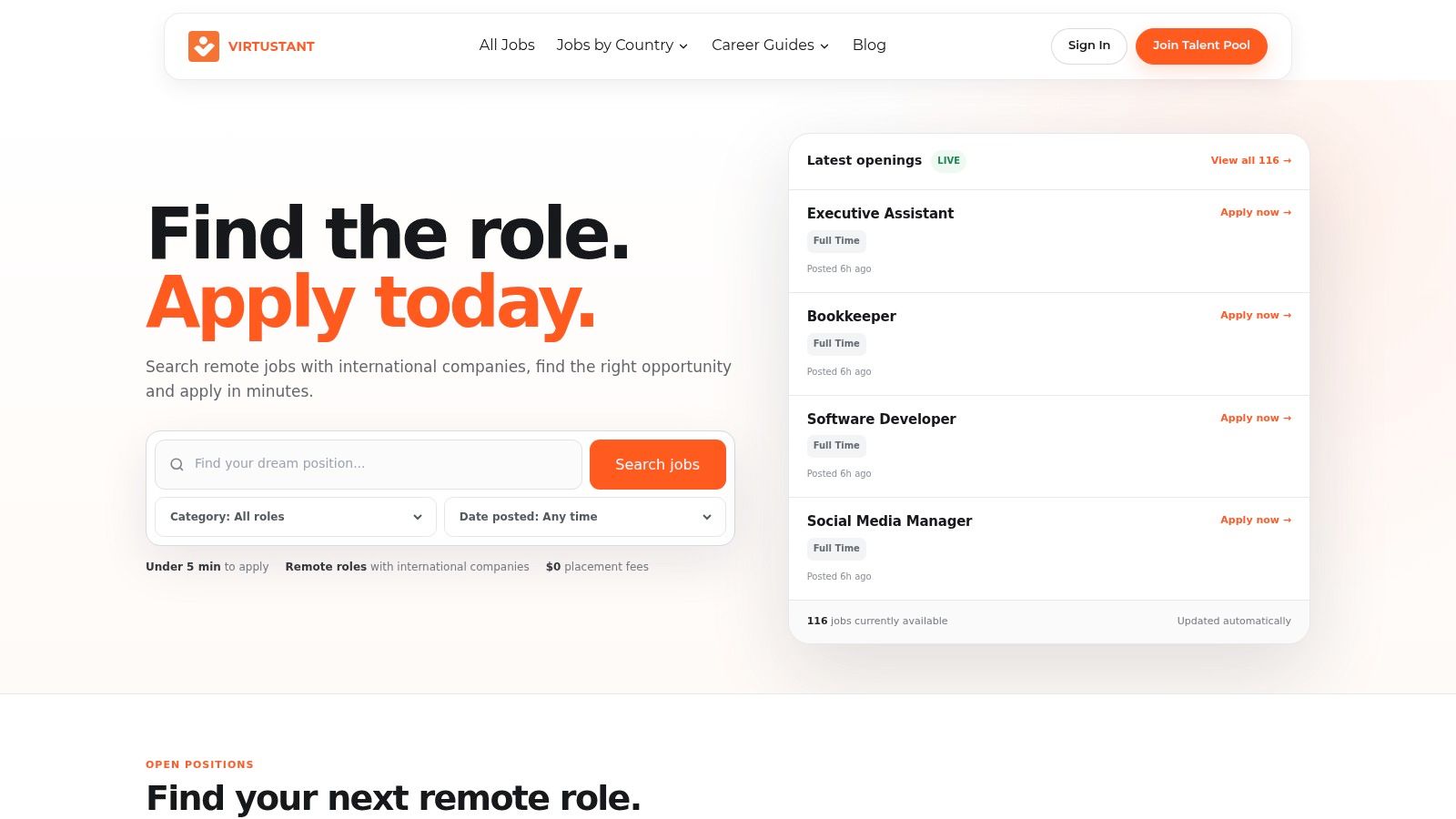
Candidates in Latin America often face a specific discovery problem. A listing may be remote but hidden among global results, omit its expected U.S. schedule, or provide too little detail about tools and English proficiency. Virtustant Jobs addresses that friction by focusing on remote roles for Latin American talent and presenting structured openings that candidates can filter and apply to directly.
The platform includes marketing and growth positions alongside administrative, customer service, sales, design, ecommerce, finance, legal, technical, and operations roles. Marketing-related listings can include assistant, manager, social media, lifecycle, outreach, paid media, and PPC work. Postings may specify responsibilities, software, schedules, experience, and language expectations, such as Excel, HubSpot, EST hours, or advanced English.
When the platform fits your search
Virtustant Jobs is a practical choice when you want:
- LATAM-focused discovery: The site frames opportunities around careers in Latin America and includes bilingual possibilities.
- Schedule transparency: Many postings identify alignment with U.S. business hours, which helps you screen for time-zone fit early.
- Structured applications: Easy Apply and short forms reduce repeated data entry, while candidate accounts support continued applications.
- Future matching: The talent pool gives applicants a way to remain visible after a suitable opening closes.
- Employment-model clues: Some postings explain whether work is full-time or part-time and may note payment in U.S. dollars or local currency.
Use the platform as a screening tool, not a guarantee of fit. Read the full posting, confirm the schedule, verify the required software, and compare the employment terms before investing in an application. For a targeted view of the category, browse remote marketing assistant jobs and then tailor your portfolio to the capabilities the listings repeatedly request.
Writing Outreach Messages That Actually Get Responses
A generic message creates more work for the recipient. A useful outreach note proves that you've looked at the company, identifies one relevant need, and makes a small request that's easy to answer. It should also read like the work you'd do inside the team, concise, specific, and organized.
For a startup founder, use this structure:
Subject: A small launch-ops idea for [Product]
Hi [Name],
I saw that [Product] recently [specific launch, feature, or content initiative]. I noticed the public workflow currently makes it difficult to [specific friction, such as finding launch assets, tracking campaign links, or following up with voters].
I'm applying for marketing assistant and growth support work. I've prepared a short sample showing how I'd organize the campaign brief, UTM structure, approval status, and post-launch report: [portfolio link].
If useful, I'd be glad to take on a defined task such as cleaning the content calendar, preparing social variants, or building a first-pass reporting sheet. Would the person managing [marketing or growth] be the right contact?
Best,
[Name]
The offer is deliberately narrow. “I can help with marketing” forces the founder to invent a role for you. “I can clean the campaign calendar and document missing approvals” gives them a concrete way to evaluate your usefulness.
Adjust the message for an agency
Agencies care about repeatable delivery, client context, and fewer follow-up requests. Use a message that emphasizes throughput without promising unrealistic results:
Subject: Support for [Agency]’s content and reporting workflow
Hi [Name],
I reviewed [specific client page, campaign, or agency article]. Your team appears to manage work across [relevant channel or service]. I've built a sample workflow that tracks briefs, asset status, approval owners, publication dates, UTM parameters, and weekly reporting.
I can support research, content coordination, email preparation, social scheduling, and reporting while keeping decisions documented in [Asana, ClickUp, Notion, or the tool you use]. Here's the sample: [portfolio link].
Are you currently adding contractor or assistant capacity for campaign operations?
Regards,
[Name]
Follow up once with a useful addition, not a demand for a response:
“Sharing one extra observation from [campaign or page]. I'd separate [audience or lifecycle group] from [another group] because the desired action differs. I've added the example to the portfolio link.”
Then stop. Respectful persistence shows judgment; repeated nudges show poor boundary awareness.
A strong outreach note should answer three questions quickly: Why this company, why this task, and why you? Avoid claims you can't prove, broad praise, attachments that weren't requested, and messages that ask for a meeting before establishing relevance.
Preparing for Remote Marketing Assistant Interviews
Remote interviews test more than personality. They reveal whether you can communicate without constant prompting, handle tools carefully, receive feedback in writing, and recover when a platform or process behaves unexpectedly.
Prepare for each assessment format
| Interview stage | What the employer is testing | How to prepare |
|---|---|---|
| Written screening | Clarity, prioritization, and attention to detail | Answer directly, state assumptions, and separate facts from recommendations |
| Asynchronous video | Structure and concise communication | Use a simple beginning, decision, example, and result format |
| Take-home task | Execution and judgment | Submit the requested work, explain your reasoning, and identify one limitation |
| Live collaboration | Listening, tool use, and response to feedback | Narrate decisions briefly, ask focused questions, and keep a backup plan |
| Culture conversation | Reliability and working preferences | Describe how you document work, raise blockers, and manage competing deadlines |
For a technical assignment, prepare a small working environment before the call. Keep a blank campaign brief, sample UTM naming scheme, spreadsheet, and content checklist available. If an analytics platform is unavailable, explain the measurement plan you would use and distinguish what you know from what you would verify.
Use your portfolio as an interview control panel
Don't wait for a question about GA4 or CRM segmentation. Bring the interviewer to the relevant project and explain the decision behind it. A good answer includes the original objective, the action you took, the evidence produced, and the next improvement you'd test.
Practice with a structured simulation such as Mock Interview Pro, then rehearse without memorizing scripts. Interviewers notice when a candidate can adapt an example to the question instead of reciting a prepared speech.
Ask the employer questions that expose the actual operating model:
- How does the team assign ownership for campaigns?
- Where do people record decisions and approvals?
- Which meetings are essential, and which updates happen asynchronously?
- How does a manager review assistant work?
- What should be completed independently by the end of the first month?
- What happens when someone works in a different time zone?
Remote fit is mutual. A company that claims to be distributed but relies on constant live availability may not offer the flexibility you expect. A team with clear documentation, realistic response expectations, and defined outcomes gives you a better chance to produce good work.
Understanding Remote Marketing Assistant Salaries and Compensation Models
The remote label doesn't tell you what you'll earn. Compensation depends on whether you're an employee, agency contractor, or independent freelancer, and on whether the employer uses market-based or location-adjusted pay.
Available 2026 guidance indicates that remote companies may pay market rates regardless of residence or apply location-based adjustments of roughly 10–35%, while international differences can reach 40–50%, according to guidance on getting hired for remote marketing work. Treat those figures as a description of possible employer policies, not a universal salary range.
Decode the wording before negotiating
- US-only: You may need U.S. residence, work authorization, payroll eligibility, and sometimes a specific state.
- EMEA or LATAM: The employer is defining an operating region, but you still need to confirm eligible countries and working hours.
- Location-adjusted: The company may use a geographic compensation band. Ask which market determines the offer.
- Authorized to work: This can mean the company won't sponsor a visa or handle an international employment arrangement.
- Contractor: You may manage your own taxes, equipment, insurance, paid leave, and currency conversion unless the contract says otherwise.
A higher headline amount can become less attractive after unpaid leave, transfer fees, tax obligations, and inconsistent hours. Compare the complete arrangement rather than negotiating only the nominal rate.
| Employment Model | Typical Pay Range | Benefits Included | Career Growth Speed | Geographic Flexibility |
|---|---|---|---|---|
| Employee | Not stated in the available data | May include benefits, subject to employer and country | Often structured | Usually limited by payroll eligibility |
| Agency-embedded contractor | Not stated in the available data | Often narrower and contract-dependent | Can be fast through varied client work | Moderate, subject to agency coverage |
| Independent contractor | Not stated in the available data | Usually self-managed unless contract specifies otherwise | Can be fast through portfolio building | Often broader, subject to client rules |
| Startup team member | Not stated in the available data | Varies widely by company and location | Potentially broad, with less formal structure | Depends on operating jurisdictions |
Negotiate the terms that affect daily life
Ask for the pay basis, currency, payment schedule, contract duration, expected overlap, paid time off, equipment policy, performance review timing, and ownership of created work. If the employer can't share a band, ask whether residence changes the offer and what evidence would support a review later.
An assistant who can report campaigns, maintain a CRM, and improve workflows holds more influence than one who only schedules posts. Show the portfolio artifact that demonstrates the capability, then negotiate around scope and review criteria rather than making an unsupported demand.
Thriving in Your First 90 Days as a Remote Marketing Assistant
Your first three months should make your reliability easy to see. The strongest assistants don't flood a manager with updates or disappear into a task board. They establish a predictable rhythm, document decisions, and connect activity to the campaign outcome.
Days 1 through 30 build context
Start by learning the team's systems. Identify the source of truth for tasks, campaign briefs, brand guidance, approvals, customer data, reporting, and urgent requests. Ask your manager how they define a completed task and what deserves an immediate escalation.
Create a personal operating note with:
- Ownership: The campaigns, channels, and recurring tasks assigned to you.
- Dependencies: People, assets, approvals, and data required before work can move.
- Standards: Naming conventions, brand rules, UTM structure, and reporting format.
- Cadence: The expected timing for updates, reviews, and weekly summaries.
Use written updates that answer what changed, what's next, and what's blocked. Don't make your manager reconstruct progress from scattered chat messages.
Days 31 through 60 take controlled ownership
Choose a small recurring process and improve its visibility. That might be the content calendar, campaign asset checklist, weekly email report, or CRM cleanup queue. Before changing the system, document the current process and confirm what the owner considers a problem.
Use an asynchronous-first procedure:
- Create the campaign brief with audience, channel, asset status, deadline, and approval owner.
- Record decisions and dependencies in one shared location.
- Review exceptions midweek, focusing on missing inputs rather than reporting every action.
- Close with a KPI summary covering reach, click-through rate, conversion rate, cost per acquisition, and unresolved blockers.
The purpose is not to produce more messages. It's to help the team make decisions with less reconstruction.
Days 61 through 90 propose improvements
By this stage, bring your manager a short improvement memo. State the observed friction, show the evidence, propose a low-risk change, and define how the team will know whether it worked. Avoid presenting five unrelated ideas. One well-scoped improvement demonstrates more maturity than a long list of ambitions.
The wider career path supports this approach. The Bureau of Labor Statistics projects that employment of market research analysts will grow 7% from 2025 to 2035, faster than the average for all occupations, with median pay of $78,760 in 2025, according to the BLS occupational outlook. An assistant who learns to organize customer data, interpret campaign results, and explain recommendations is building toward analytical work, not remaining limited to administration.
Visibility is a system: Keep a weekly record of completed work, decisions supported, issues prevented, and improvements proposed. Your manager shouldn't need to remember every contribution unaided.
Ask for feedback at defined points, such as after a campaign cycle or reporting period. At the end of the initial review period, summarize your responsibilities, evidence, and next-scope proposal. That gives the employer a clear basis for extending the role, increasing responsibility, or discussing better terms.
Choose three target employers this week, verify their geographic and schedule requirements, and create one portfolio artifact that matches the work they need. Then send a custom application or outreach message that links directly to that evidence. Remote marketing assistant jobs reward candidates who make their value easy to verify, so replace broad applications with documented proof and a clear next step.